Sunday, 20 August 2017

Mix-up your workouts for continued running improvements


Ever wondered why after a point the improvements in running timings begin to saturate for most runners? The reasons could be many – however, in most recreational runners this happens due to the similar nature of the training stimulus. A particular exercise works on a given set of muscle groups. Now, if the body is subjected to a similar workout regime for a long time, the body starts getting used to it and this slows down any gains in the overall fitness level. This blog outlines a few effective workouts that runners could include in their strength training regime (to build more variety and fun in their training).       

First things first – why is strength training important for runners? The simple answer is that without strength training a runner is more susceptible to injuries. Moreover, when it comes to long distance running, endurance plays a critical role. Strength training can help improve endurance and enable the runner to finish strong.


So, let’s turn our attention to the next important question - what are the best strength workouts that a runner should perform? The answer really depends on for how long one has been running and what kind of strength regime one has had. If a runner has had limited or no strength workouts in the training regime, the best place to start is with basic workouts like squats, lunges, push-ups, plank-holds and burpees. These are basic body-weight based workouts which can be performed just about anywhere. 

The challenge comes when one has been performing these basic workouts for a while (in addition to the regular running), but the improvements in running performance have started to saturate. This is something that I faced about a year back. It is probably an indication that the body has become used to the same kind of workouts (with the same muscle groups getting activated due to a lack of variety in the workouts). To address this challenge, I have been trying to embrace new workouts over the past six months. While the options one has to mix up the workouts is potentially infinite, in this blog I am describing below some of my favorite workouts that I have embraced recently.

(1) Spinning
Equipment required: Spinning bike
Primary impact areas: Cardio conditioning, Legs


(2) Tractor tire exercises
Equipment required: Tractor tire, Hammer
Primary impact areas: Overall body strength, Core, Shoulders


(3) Monkey bar workouts
Equipment required: Hanging bar
Primary impact areas: Core, Cardio


(4) Resistance running
Equipment required: Resistance band
Primary impact areas: Quads, Glutes, Calves, Core


(5) Jump push-ups
Equipment required: No specific equipment needed
Primary impact areas: Cardio, Shoulders, Overall body strength


(6) Rope waves
Equipment required: Workout rope (hinged firmly at a pivot)
Primary impact areas: Shoulders, Back, Lats, Cardio


(7) Box jumps
Equipment required: Stable box jump equipment (preferably with rubber edges for additional protection)
Primary impact areas: Core, Cardio


(8) Inverted Abs Crunch
Equipment required: Stable hanging bar
Primary impact areas: Abs, Core


(9) T-Bar twists
Equipment required: T-bar hinged to a stable pivot
Primary impact areas: Core, Shoulders


(10) Rope climbing
Equipment required: Workout rope hinged to the ceiling
Primary impact areas: Core strength, Overall body strength


I hope this blog provides my fellow runners some new ideas for mixing up their strength workouts. 

[Credits: All workout pics have been taken at Bomiso Gym's South City-1 facility. Thanks to my running buddy Rahul Dhanda for taking the pics).

#BomisoGym
#StrengthTrainingForRunners
#TomTomSpark3
#GetGoing

Sundeep Singh
+91 - 98181 19794

About the Author: By background, Sundeep Singh is a Mechanical Engineer from IIT Delhi and holds an MBA from IIM Kozhikode. Given his flair for mechanics and passion for running, he loves to analyze and write about the finer nuances of running techniques / strategies. Sundeep’s best run till date is NDM 2017, which he completed in 1:28:33.


Sunday, 16 April 2017

Falling in love with running all over again with TomTom Spark 3!


I recently attended a full-day workshop on design thinking. At some point during the workshop, the trainer mentioned – “what can be measured, can be managed – and this is more and more relevant in today’s age of connected devices!”. The statement may have been made in a very different context, but it somehow made me think of my new TomTom Spark 3 watch. I spent a few moments reflecting about the various cool features that the watch offers, before deciding to get back (mentally!) to the workshop. This blog is a detailed account of the specific thoughts that flashed in my head during those split seconds of distraction during the workshop. 


Yes, it’s true – what can be measured, can be managed! And, this applies to just about everything that is worth measuring or tracking. As a new runner, the simple parameters that one cares for includes distance and pace. As we get more sophisticated, we tend to get a little more demanding from our training sessions and start caring for slightly more nuanced variables like stride turnover, timing splits and heart rate. 

Let’s look at how TomTom Spark 3 can help runners with these varied needs and more. To keep the description specific, I have organized these features into three broad categories: (i) Standard output features (to analyze the run), (ii) Advanced training features (features that help bring method to madness during the training runs), (iii) Race day features (features that I rely on during a competitive run).   


(i) Standard output features
At a very elementary level, the essence of long-distance running is captured through this basic equation:


In a very simplistic sense, this means that one can run better if one can build the ability to run for longer duration (time), maintain a higher stride turnover (steps / time), and take bigger steps (meters / step). The standard output dashboard that one sees post a TomTom run outlines these basic metrics along with a few more such as energy spent, heart rate etc. (see figure below).


In addition to these summary parameters, I particularly find it useful to note the following statistics on the summary dashboard:
  • Overall splits and a graph of how my pace fared across the distance run - a relatively horizontal curve indicates a controlled run where one could manage the pace well throughout the run. On the other hand, a curve with too many spikes and troughs may indicate that one was trying too hard and hence struggling to hold a uniform pace.
  • Heartbeat across the run – this is a particularly important variable as it holds the key to running faster and longer (more on this feature in the advanced training features section below).


(ii) Advanced training features
Heart rate training
One of the most important (and often most neglected!) parameters in running training relates to heart rate. Depending on the running objective and distance, the heart rate should ideally operate in a specific zone (see illustrative figure below).


Now depending on the overall objective, one must train in a particular zone. For instance, if someone is training for a specific HM timing, then spending too much time in sprint zone (running short intervals / 5Ks) may not be too beneficial – this is a mistake I made quite a lot about a year ago. That’s where TomTom watch helped me significantly. What it does is, it breaks the entire run into fraction of time spent in each zone. Below, I have captured an output from two different training runs I completed recently and highlighted how the two differ in terms of suitability for different objectives.


Race against a specific target
For me, the real value that Spark 3 offers lays in a host of training features that it offers. In particular, it offers the following advanced training features – Goals, Intervals, Laps, Zones, Race. 


  • Goals: This feature allows you to run against a pre-determined target. These targets may be set based on the overall training objective. For instance, a runner looking to reduce weight may set the target to burn a specific number of calories (and not worry about distance or time). Similarly, a runner training to complete a full marathon and looking to build mileage may set a distance target.
  • Intervals: This is another feature that I tend to use a lot. Of the four days that I run in a week, I usually spend one session on interval runs. This feature allows you to customize your own interval run by entering a predetermined warm-up time, cool-down time, rest-time between intervals, specific interval running distance or duration.
  • Laps: This feature allows you to set-up a specific lap distance post which the watch displays metrics such as duration and pace for that lap. I usually prefer setting the lap distance to 1km.
  • Zones: For a long time, I had a knack of running first few kilometers faster than the desired pace (only to struggle in the last few kilometers). This feature allows you to train to run within a heart-rate zone. During my tempo-runs, I feed-in a desired heart rate zone. This ensures that if the heart beat goes above a threshold, I immediately get an alert on my watch, which allows me to take corrective action. This is a feature I used extensively to train to get to my first sub-1:30 half-marathon.
  • Race: This feature is helpful to find your ‘race partner’, especially when there aren’t too many runners in your running network who look to run at your pace. It allows you to run against your personal best or any previous run – a great feature for those looking to strike a PB (wherein one is competing against his / her own timing from a previous run). 

(iii) Race-day features
So, you have spent months training for the big day – and finally the big day arrives! What features should you leverage during a competitive run? The answer to this would vary for different runners. For me, I like to keep it very simple on the race day and just like to use two key features.

Average pace display
About a year back, I had a knack of conducting multiple mental calculations during the competitive run – all related to what’s the average pace till now, how much time is remaining to complete the run within the desired timing etc. It all used to be a bit of a distraction from the simple act of running. This is where I love to use the average pace display feature.

During the run, the watch is capable of displaying 3 data points in one screen (see figure below). The two at the bottom can be adjusted and fixed before the run starts, while the large metric display at the center allows you the option to look through the following available metrics (by scrolling up-down during the run) – average pace, average speed, instantaneous pace, instantaneous speed, clock, duration, distance, calories, heart rate, heart rate zone. 


How do I use it? If I want to run a HM in sub 1:30, then I have to maintain an average pace of 4:16 throughout the run. As such, I set the center metric to display average pace and that’s the only number I care for during a competitive run. Every now and then I would just glance at the magical figure at the center of the watch. If the figure is still below 4:16 then I have some buffer and if it starts shooting above 4:16 then I need to do a bit of catching-up to complete the run in sub 1:30. From experience, I have realized that keeping the pace in the range of 4:10 to 4:18 in for the first 15kms of the run allows me to complete the HM in sub 1:30.

Load your music metronome beats on the watch!
This is the feature that almost made me feel that the watch has been designed exclusively for me. I have been running for almost three years now and have come across a variety of gadgets to carry music for the run. Whatever be the equipment (iPod, Mobile, Walkman etc.), it always felt like extra ‘load’ to be carried during the run. Well – that’s a thing of past now. TomTom Spark 3 offers a cool feature to carry almost 3GB of music on the watch itself. Be it Bhangra beats or Metronome beats, I have the option of loading it all on my sleek watch now. This is where the point I made at the beginning of the blog (around connected devices) becomes relevant too. The watch comes with a simple and light headphone which can be paired with the watch (through Bluetooth).


Through this blog, I have tried to share some of the cool features that I have been using in my TomTom Spark 3 watch. This is by no means intended to be an exhaustive description of the features and I know there are many features that I am yet to start using!

If you too are using a TomTom watch, I would love to hear your thoughts on the features you use the most.

Sundeep Singh
+91 - 98181 19794

(#TomTomSpark3; #GetGoing)

About the Author: By background, Sundeep Singh is a Mechanical Engineer from IIT Delhi and holds an MBA from IIM Kozhikode. Given his flair for mechanics and passion for running, he loves to analyze and write about the finer nuances of running techniques / strategies. Sundeep’s best run till date is NDM 2017, which he completed in 1:28:33.

Sunday, 5 March 2017

My tryst with God


At the outset, I would like to appropriately qualify this blog. “My Running Reflections” is supposed to be a running blog, but this one qualifies as something far more sacrosanct for me - something that extends beyond the boundaries of running or any sport for that matter. It’s about an ephemeral moment when I revisit some sweet childhood memories – all within a matter of few seconds!  

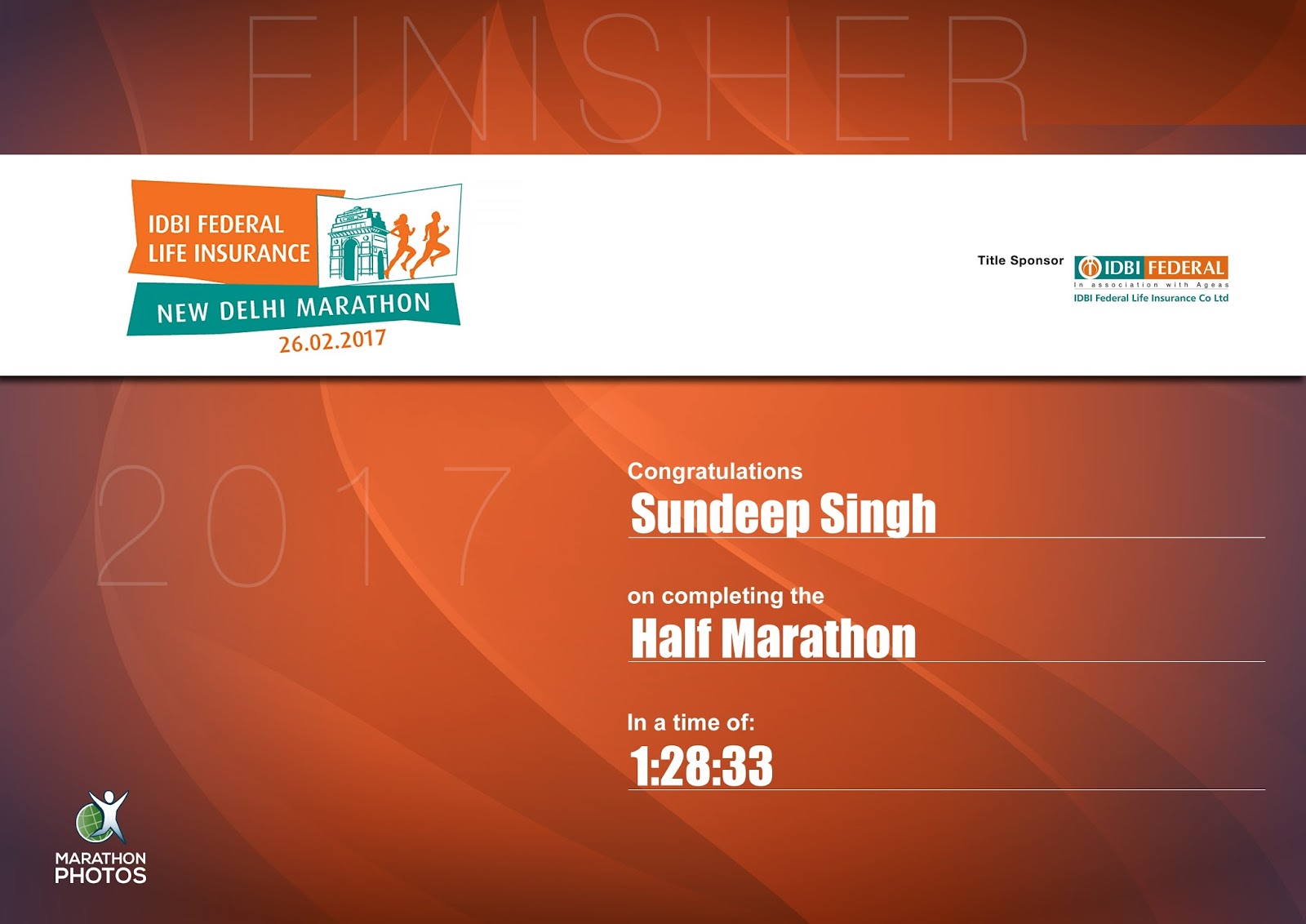
IDBI Federal Life Insurance – New Delhi Marathon (26th Feb 2017)
It was around the end of 2016 when I learned about Sachin Tendulkar’s association with the NDM event. For the first time, a running event was going to be more than just a running event for me. I was charged up to give my best performance on the big day. The months of January and February were largely focused on speed work with tempo and interval runs forming a significant share of weekly running mileage. 

The days passed by and then comes the big day - 26th Feb, 2017.

The excitement was in the air. As I entered the Stadium, I continued performing my ritual warm-up drills, but my mind was elsewhere. I kept scanning the sea of people to catch a glimpse of my childhood Hero – the Master, the Blaster, the God – the One and Only, Sachin Tendulkar.

All warm-up drills performed, pre-run banana eaten, pleasantries with fellow runners exchanged – still no sight of Sachin Tendulkar. I was disappointed at the hype I had created in my own mind. For the last two months, all I had thought about during my personal time was the sight of Sachin Tendulkar flagging-off the race and I achieving my best ever half-marathon time on that magical day!

But, alas - that was not to be.. 

With a feeling of despair and utter disappointment, I accepted the fact that Sachin had not come. I bent down to tighten the shoelace for one final time before the run commenced. Just as I gingerly tied the shoe-lace knot, I heard a loud boisterous eruption. Even before I got up to see what it was – a broad smile had flashed on my face; I knew the master had arrived.

What I saw next was intense, emotional, nostalgic and beyond words. With a large flag in his hand, Sachin stood just a few meters away from me (the fact that I made it to the first few rows from the start-line helped!). 


The first thing that struck me at seeing Sachin was the radiant glow on his face – a glow that one cannot be born with, a glow that certainly cannot be acquired through the use of cosmetic creams – a glow that one attains through single-minded focus and dedication and going through the grind for one’s quest for excellence day after day, month after month – for almost 25 years! 

A few moments later, I felt a sudden turbulence of thoughts and flashbacks from my childhood days. It was almost like the sight of Sachin had nudged a few blocks of nostalgic memories that were comfortably placed beneath the layer of sub-conscious memory, and were now trying to regain equilibrium. Some moments that instantly crossed through my head:

  • IIT Delhi second year, Karakoram hostel (2002): We were watching a one-day international match in the Hostel common room and Sachin got dismissed cheaply. The gentleman sitting next to me (an M. Tech student three years senior to me) was visibly disappointed and started abusing Sachin like crazy. After exercising restraint for a few minutes, I decided enough was enough and beat that senior like a mad man. Subsequently, I was banned from the hostel common room for six months. Well, I was a kid back then with limited maturity (but in no way suggesting that with the advantage of maturity that I have gained over the last 15 years, I wouldn’t do that again – I still believe that the gentleman got the treatment he deserved!)
  • The day of my Roka ceremony (2nd March, 2008): I was getting engaged to my would-be wife! Everything was great – all relatives were ecstatic, grand preparations had been made at a Banquet Hall. The only little bit of a concern (at least in my mind) was that the day coincided with Common Wealth Bank Series, 1st Final – India vs. Australia. As the function progressed, I kept furtively escaping every few minutes (on the pretext of feeling hungry, nature’s call, need water and what not) to catch a glimpse of Sachin on a large screen where the match was being telecast in an adjacent restaurant. The master scored an unbeaten 117 and the auspicious day became a little more auspicious.
  • Sachin’s retirement day (15th Nov 2013): As a kid, I always feared what would I do when Sachin retires. It almost felt like I would not have anything to look forward to. But of course, those were thoughts as a kid. Now, I had grown up – in fact, I was a father of a 3-year old kid. When Sachin walked back after getting dismissed for 74 for the final time, I just couldn’t hold back tears. Yes, I cried like a kid (yes, it was embarrassing, but so be it!). My kid was visibly concerned to see me weeping and looked at his Mom to explain what was going on. My wife explained to him that Papa is sad because he will not be able to watch Sachin’s batting anymore. The three year-old kid came to me after a few moments and said – Papa, Youtube pe dekh lenge (we will watch him on YouTube). As innocent as it may have been, it did give me a lot of comfort!

There were many other spontaneous flashbacks, but these were the prominent ones – all within a matter of few seconds.

The run started..

Sachin was cheerfully looking at the passing cavalcade and cheering the runners. What happened next was magical. There was a brief moment when Sachin and I made an eye contact. Sachin smiled and showed me a thumbs-up. Of course, he was doing that to the crowd but for that brief moment it felt like it was a personalized good-luck gesture for me.

The energy level went through the roof. After that magical moment, there was no way I was going to settle for anything less than my personal best.

The challenge for me was to hold the nerves and run as per the plan. I often make the mistake of running the first few kilometers faster than the desired pace. I had planned to take at least 20:30 for the first 5 kms. At the end of 5 kms, I realized that I had deviated from the plan by good 45 seconds and finished it in 19:45. I did manage to get back on the plan after around 8th km mark and by the time I finished the race, I had managed to achieve a new PB for half-marathon distance – 1:28:33 (bettering my previous best by 1 min and 6 seconds).


Clearly, it was a race that I would remember for reasons bigger than just my personal best timing! My tryst with God was magical and the lucky charm seemed to have continued into the next big event too.

Urban Stampede 10km run (5th March, 2017)
Managed to secure second rank with my personal best timing of 40:47 for 10 km run.


So, back to the original topic - The Tryst with God. 

What next now? The desire to meet Sachin remains and meet in a more personalized manner. But, it should feel like a meeting earned through hardwork, discipline and elevation of self to a level where the meeting makes sense not just for me but also for Sachin - and, I have miles and miles to go before even remotely  entertaining a thought like that!  

Sundeep Singh
+91 - 98181 19794

#TomTom
#GetGoing

About the Author: By background, Sundeep Singh is a Mechanical Engineer from IIT Delhi and holds an MBA from IIM Kozhikode. Given his flair for mechanics and passion for running, he loves to analyze and write about the finer nuances of running techniques / strategies. Sundeep’s best run till date is NDM 2017, which he completed in 1:28:33.

Sunday, 27 November 2016

The pursuit of 1:29:xx

As I anxiously stood at the start line of the Airtel Delhi Half Marathon (ADHM) 2016, a myriad of memories flashed through my head. I thought about several occasions on which I missed the sub-1:30 mark, I thought about the 4:00am wake-up routine over the last several months, I thought about the fun training moments spent with my close friends over the past few weeks, I thought about the final taper week, I thought about the pasta lunch I had with my close friends a day ago…It felt like a lot passed through my head. Before I could think of anything else, the ‘mad-rush’ started..


The background
Before I describe the journey (or the pursuit of 1:29:xx, as I love to describe it) a bit of a background on how it started. About two years ago, when I had started running I had very limited understanding of what half-marathon is all about. It had started almost out of my whimsical desire to try something new. Why? Because, I had known a few other people doing it. At that stage, I had a simple discussion with a friend at work about what a good finish time looks like for half-marathons. The discussion progressed like a typical conversation between strategy consultants:

Sundeep: “What’s a good finish time for a half-marathon?”
Friend (after a bit of thought and consideration): “It depends.”
Sundeep (with visible exasperation): “OK – that doesn’t help much. Go on...”
Friend (unperturbed): “It depends on factors like your age, body conditioning, how long you have been running etc. etc.
Sundeep (still not happy with the answer): “OK – so for a physically fit runner who has been running for a few years and who is around as old as me…and you can make some intelligent assumptions...– what would be a good half-marathon finish time?
Friend: Officially, if you do it in 3 hours, it is regarded as a formal half-marathon finish; Kenyans can do it in 1 hour. If one does it in within 90 minutes it is considered quite a decent pace”

Grossly overestimating my physical abilities, I told my friend that I intend to do my first half-marathon in 1 hour 29 minutes and a few seconds. The friend had an amused smile. Without saying anything explicitly he dismissed what I had said as an ignorant remark. It didn’t take me long to understand why.
  • On 12th October 2014, I did my first half-marathon in 1:47
  • On 23rd November 2014, I did my first ADHM in 1:43

About a year later, I was able to finish three half-marathons where I came within striking distance of my aspirational timing:
  • ADHM 2015 (Nov 2015): 1:31:20
  • NDM 2016 (Feb 2016): 1:31:00
  • Fastest running and living HM (Mar 2016): 1:30:40

 The gap may have appeared just about a minute or so. However, it was good 60 odd seconds which would just refuse to go away. With that started a serious desire to do 1:29:xx. 

3 months training period: Sep – Nov 2016
It was around September 2016, when the training for ADHM 2016 started in all earnestness. By this time, I had gathered sufficient understanding of what a typical training cycle looks like. However, there still were a few gaps which had to be addressed. In particular, there are three things which I was not doing correctly. I am sharing the same below and hope that it might be helpful for runners with similar aspirations.

Mileage is not everything, but it still matters – probably more than most other things!
I have always been a firm believer that strength training has a huge role to play for any long distance running (and I continue to believe that). However, earlier I often underestimated the importance of clocking mileage and my typical weekly workout schedule would look like 3 – 4 days strength training and around 2 days running. The turning point in my understanding came when I had a chat with Shiv Gahlot, our local Boston Qualifier (once again, if you are reading this – thanks buddy!). Besides sharing some serious training tips, Shiv suggested reading a book on Advanced Marathoning by Pete Pfitzinger.


This has been massively helpful and I highly recommend this book to any serious runner. Since reading this book, my weekly workout schedule comprises of 1 – 2 strength training sessions and around 4 runs. Once again, in no way undermining the importance of strength training (and it is critical to avoid injuries), but just highlighting how running is important to improve as a runner!

Each training run has a purpose – got to respect it!
My weekly workout schedule now comprises of 4 runs a week – an interval run, a tempo run, a medium long distance run and a long distance run. The beauty and finesse lays in understanding what is the right pace to run each of these runs. Earlier, my tempo run used to be an effort to run 10K as fast as possible. The interval run used to be an effort to do some sprint repetitions. Occasionally, I would also do a 5K and try to achieve my PB without realizing where it really fits into the overall training plan for half-marathon. A lot of these misunderstandings got addressed after reading the book by Pete. The three months leading to ADHM days comprised of very specific runs – to be run at a particular pace (not faster, not slower!) with a specific objective. More on this subject on some other day.

Race day planning matters - Break it into smaller components.
21.1K is a fairly long distance and a lot can go wrong if one doesn’t plan the run. This is where an honest introspection of one’s own physical abilities (body conditioning, nature of flagging during training runs, level of fatigue, typical pace limiting factors etc.) close to the race day is critical. Equally critical is to plan the big day race based on a clear understanding of these factors. A simple race day plan could look like:

For me to finish 21.1K in a given time, I need to do 14K in x minutes. For that to happen, I need to finish 10k in y minutes. For that to happen, I need to do 5K in z minutes…
...and more importantly - understanding if x, y and z are really achievable with the current level of body conditioning.

It often helps to have a close friend critique this and keep you honest in such an assessment. This is where my running buddy Rahul Dhanda really helped me through innumerable discussions close to the big day. The plan for me was simple:

21.1K in about 89 minutes, 14K in about 59 minutes, 10K in about 42 minutes, 5K in about 21 minutes – and yes, we did believe it was achievable.

The big day: 20th November 2016
When one attaches too much importance to something, it is bound to put undue pressure. I was no exception. The race day almost felt like JEE day or like CAT day for me. Standing at the start line, I was not sure if cracking JEE / CAT was more difficult or if finishing 21.1K in the next 89 odd minutes would be more difficult.

As I anxiously stood at the start line, a myriad of memories flashed through my head. I thought about the previous edition of ADHM, I thought about several occasions on which I missed the magical sub-1:30 mark about a year ago, I thought about the 4:00am wake-up routine over the last several months, I thought about the fun training moments spent with my close friends over the past few weeks, I thought about the taper week that had just gone by, I thought about the pasta lunch I had with my friends a day ago. It almost felt like an eternity before the race started and each passing moment was adding to the anxiety. I kept casually jumping on the spot to keep the body warm.

At 7:10am the race started, and how relieved I was to be able to switch from vertical jumping motion to the linear horizontal motion! The race commenced as per the plan: 5K in 20:10, 10K in 41:09, 14K in 58:30…and finally, yes finally 21.1K in 1:29:39.

It was a moment of joy, joy that can be felt but not expressed..


What next? - Time to briefly cherish the moment and start a new pursuit!

--------------------------


Sundeep Singh
+91 - 98181 19794

About the Author: By background, Sundeep Singh is a Mechanical Engineer from IIT Delhi and holds an MBA from IIM Kozhikode. Given his flair for mechanics and passion for running, he loves to analyze and write about the finer nuances of running techniques / strategies. Sundeep’s best run till date is ADHM 2016, which he completed in 1:29:39.

Wednesday, 31 August 2016

All it takes is ALL you got...and at times a bit more!

As I boarded the flight to Hyderabad, I continued to think about the big event (AHM 2016 – Half Marathon) on the following day. In the months leading to the event, I had done fair amount of training and was confident of a sub-100 mins finish on the hilly course of Hyderabad. However, I had those pre-race day anxious moments where I kept thinking – maybe I should have done some more hill runs, maybe I should have done a bit more strength training for legs and what not. This article describes the beautiful memories from the point I boarded the flight to the point I crossed the finish line on the following day.

I realized that thinking about the event on the following day was only adding to anxiety. As the plane took-off, I put on my headphones and listened to music to divert my thoughts. As always, music helped – though only for a short duration on that particular day, and I was soon back to my dream world where I continued fantasizing about crossing the finish line in less than 100 minutes.

About half an hour into the flight, the air hostess arrived with refreshments. I was not going to take a chance with any outside food a day before the race and was carrying my own food. I carefully got up and grabbed my bag in which I was carrying 6 different meals that I had planned to have through the day.
…The first meal to go down my throat was a healthy fruit salad
…shortly thereafter, I had a bowl of pasta
…and just before the plane landed, I managed to finish the idlis too.

I did notice the gentleman sitting next to me quizzically staring at me and (probably) wondering – “this Sardar ji eats like crazy!” But it was all a part of the pre-race Carb loading plan, which we runners are well aware of.

On landing, I immediately went to the expo to collect the bib. I had promised myself that I wouldn’t spend much time socializing with friends and would get to the hotel room as quickly as I can. After catching-up with a few friends, I headed back and was in the hotel room by 1:00 pm. I had all the time in the world to sit alone and relax before the race day. On most occasions it is a good thing, but it can also lead you to over-think and can add to anxiety. For me, I think it was the latter on that day. I went-off to sleep at around 6:30 pm. At around 3:30 am I had a dream (rather nightmare!) – I saw that somehow the length of my shoelace has become unmanageably long, about a meter long, and I just couldn’t manage to tie a knot even after the race started. It was one of those terribly ‘real’ nightmares. I got up with a shudder and immediately picked up the shoe lying next to my bed, ready to be worn and taken around the hills of Hyderabad. I was relieved to notice that the shoelace length was exactly what it was supposed to be!


…so, there I was ready and raring to hit the road, standing and warming-up at the start line. The much awaited moment had arrived! If there were any butterflies in the stomach, it was soon a thing of past. The run started well and it got better as it progressed…

05 km – 00 : 22 :43 mins
10 km – 00 : 45 : 58 mins
15 km – 01 : 10 : 17 mins
20 km – 01: 34: 21 mins

While crossing the 20th km mark, I was fairly certain that I would manage the sub 100 mins finish that I was so keen to achieve on this hilly course. My chest swelled with pride as I continued to march along the final km of the run. In a moment of (pre-mature) self-glorification, I remembered the title of the blog I had written exactly a year back after completing the same race –

“All it takes is ALL you got!”

What I didn’t realize was that the run was not over yet and half-marathon distance is 21.097 km (good 97 meters more than 21 km). The sub-100 mins finish was slowly but surely slipping away, without my realizing it. 

Around 20 meters from the finish line, I noticed the watch cross 01: 40 mark. It was disappointing to not finish sub – 100 mins after getting so close. As I crossed the finish line, I thought –

“All it takes is ALL you got…and at times a bit more!”

On the brighter side, every moment from the plane taking-off from Delhi to crossing the finish line was worth it. These are memories to be cherished forever.


What next?

Airtel Delhi Half Marathon (ADHM 2016) is not far – very keen to find that “bit more” ahead of the mega event...

---------------------------

Sundeep Singh
+91 - 98181 19794

About the Author: By background, Sundeep Singh is a Mechanical Engineer from IIT Delhi and holds an MBA from IIM Kozhikode. Given his flair for mechanics and passion for running, he loves to analyze and write about the finer nuances of running techniques / strategies. Sundeep’s best run till date is ADHM 2015, which he completed in 1:31:20.